In the words of prominent feminist and social activist bell hooks, the "feminist movement will be sustained only if the needs of masses of women are addressed." It is evident, however, that gender stereotypes are equally damaging to both genders, and it is the role of the constantly evolving feminist movement to address the double standards that exist for both genders in multiple aspects of life.
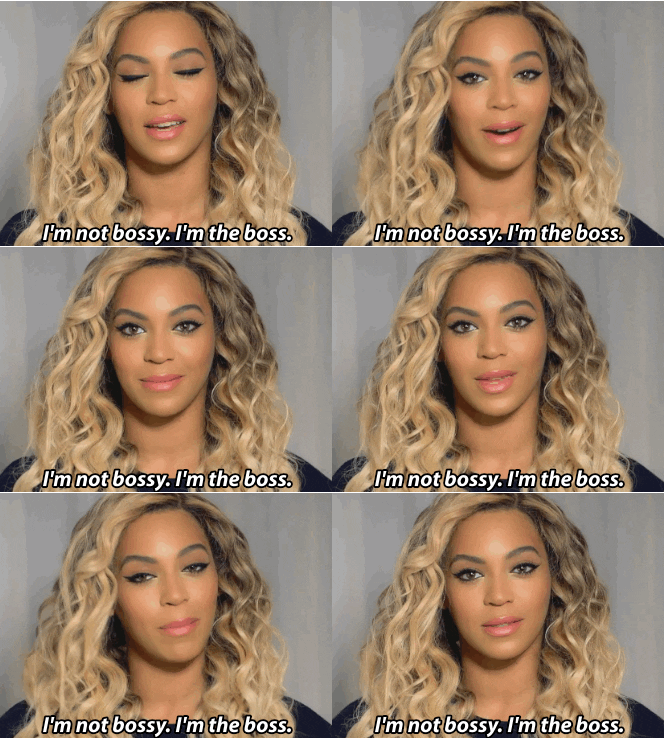
While guys are generally encouraged to be direct and commanding, as society views these traits as integral to effective leadership and CEO material, girls are discouraged from doing the same because they will come off as bossy or bratty, and we all know girls can't be CEOs, right? And if guys aren't able to be direct and commanding, they will come off as being a submissive push-over.


2) Beauty Standards
The current feminist movement does well in addressing the unrealistic body expectations of females. Society imposes "the perfect body" as skinny with certain accentuated sexual features. The current feminist movement, however, does not also address the over sexualized body images of men in many advertisements, presenting them as very apparently chiseled and muscular figures.
The above examples are just a sliver of the countless gender expectations imposed on both males and females. The emergence of the feminist movement in the 60s served to counter gender inequalities. At that time, the disparity between males and females was much greater than it is today, and the purpose of the feminist movement was to address the female perspective of these inequalities. However, with an evolving society that imposes gender norms, the "future feminist movement will be sustained only if the needs" of both men and women are addressed (hooks 107).

Nice post, Michael! I very much agree with the idea that gender is restricted and shaped by society. Even beauty, something unique and personal, can be shaped by expectations. But last year I did a research project on the idea of beauty for each gender, and found a lot of statistics and results that pertained to beauty being not a choice made by society, but one made by genetics. Beauty, as decided by evolutionary biologists, is dependent on the physical capabilities of being the primitive nuclear family. For instance, curvy women are valued more as it shows higher levels of estrogen, consequently leading to increased possibility of healthy children from regulated reproduction systems. From this, I wonder what other things are similarly affected? Perhaps gender is meant to be separate? Thanks for giving me something to think about!
ReplyDeleteHi Michael great post. I really like how you addressed how gender stereotypes are damaging to both females and males. This is something that isn't really recognized in today's society and is really important.
ReplyDeleteI really enjoyed this post! Well done, Michael. I liked that you traced how from birth to adulthood, gender stereotypes arise and evolve, and then your shift in focus to the double standards that exist in our society. Beauty standards are a big part of gender stereotypes and I like how you provided examples of how commercialization sparks these standards (an increasingly prevalent issue, as technology is advancing and not only traditional commercials, but social media can also alter how people view gender roles).
ReplyDeleteI like how you took the piece further and addressed body image/standards, since it is such a prevalent issue in today's society. Great post!
ReplyDelete