Amidst the current state of political turmoil and muddled by the slanted free press, political correctness becomes yet another divisive issue; conservatives claim the sensitivity of society detracts from the common sense while liberals claim the changing language reflects a society of diversity and inclusion. Where do we draw the line?
In November, the American population voted in a demagogue, hailed for not actually being a politician and being able to speak his mind. Criticized for calling women "pigs," immigrants "rapists," and Muslims "terrorists," Trump claims it is an issue of an increasingly politically correct country. In early February, Breitbart editor Milo Yiannopoulos was forced to cancel his speech at UC Berkeley after violent protesters made it clear his rhetoric violated the principles of inclusion, a form of "intolerance (in the name of tolerance)." Conservatives were outraged by such a limitation of free speech. Liberals said it was not a matter of free speech; rather, it was a limitation on hate speech. The line becomes blurrier and political epithets are thrown across the aisle.
The nature of language should be to fit the message with accuracy and clarity; "let the political chips fall where they may." The "hijacking" of language on both sides of the political spectrum distracts from the severity of the issues at hand. There is no need for worrying about where to draw the line if there is no need for one at all.
Unlike conventional campaigns, my campaign is not about votes. Unlike conventional campaigns, my campaign is less about public opinion than it is about self reflection and analysis of societal issues that will be discussed in 11 AP English, which, in turn, can (and hopefully will) incite thoughtful public debate. *Forewarning: look forward to countless Beyonce references!!
Mar 18, 2017
Mar 12, 2017
EPA and What it Really Stands For
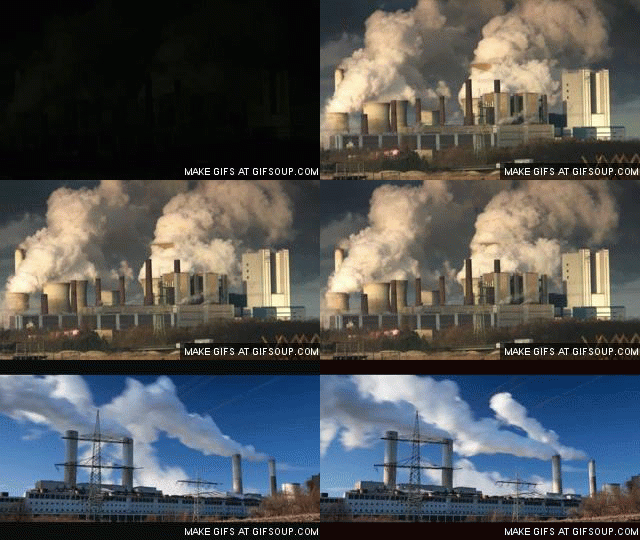
In "Save the Whales, Screw the Shrimp," Joy Williams criticizes the Environmental Protection Agency for its lack of strict regulation so as not to impede on economic progress- a sort of Economic Protection Agency. With Trump's administration, it's hard to distinguish between our worst nightmares and the harsh reality of it all.
The Bulletin of Atomic Scientists announced that the Doomsday Clock was moving 30 seconds closer to the end of humanity in an "unpresidented" act; never before has the Clock been moved as a result of a single person, but Donald Trump's alarming remarks on nuclear advancement and climate change has a resounding effect. Scott Pruitt, an outspoken climate change denier, is the newly appointed and confirmed Administrator of the EPA (never mind the fact that he has sued the EPA on 13 occasions). He disagrees with the facts on climate change and its effects on the health of the environment: after all, we are in an "age of radical subjectivism." Under this administration, Trump will oversee massive cuts to the budget, employment, and work of the EPA, allowing corporations to run its roads and tracks through the land like a synthesized backbone, to purge its sludge in the lakes, and to emit loads of gas into the vast atmosphere. Like the "poor old sea turtle [...] depositing her five gallons of doomed eggs," even a most natural process seems manufactured.
This, I argue, is not a case of ignorance: it's one of purposeful self-destruction.
The Bulletin of Atomic Scientists announced that the Doomsday Clock was moving 30 seconds closer to the end of humanity in an "unpresidented" act; never before has the Clock been moved as a result of a single person, but Donald Trump's alarming remarks on nuclear advancement and climate change has a resounding effect. Scott Pruitt, an outspoken climate change denier, is the newly appointed and confirmed Administrator of the EPA (never mind the fact that he has sued the EPA on 13 occasions). He disagrees with the facts on climate change and its effects on the health of the environment: after all, we are in an "age of radical subjectivism." Under this administration, Trump will oversee massive cuts to the budget, employment, and work of the EPA, allowing corporations to run its roads and tracks through the land like a synthesized backbone, to purge its sludge in the lakes, and to emit loads of gas into the vast atmosphere. Like the "poor old sea turtle [...] depositing her five gallons of doomed eggs," even a most natural process seems manufactured.
This, I argue, is not a case of ignorance: it's one of purposeful self-destruction.
Mar 5, 2017
Liberation through Diversity
In her essay, Deborah Tannen claims that "there is no unmarked woman." Every bit of a woman, from her "decisions about hair, clothing, makeup, and accessories," is under scrutiny; men, on the other hand, have the luxury of choosing between marked and unmarked styles. While biological and linguistic bases for being marked exist, it is established social norms that truly cultivate stigmas against marked styles. The solution, I would argue, is exposure to and acceptance of diversity where everyone is marked in an individual sense and being unconventional is the new established norm. Is it possible? Perhaps not (not anytime soon anyway).
Alienation based on physical differences is not foreign to the history of the world, not even in the recent past. In 2011, France instituted a ban on the burqa. a veil worn by an estimated 2,000 women out of the 5 million Muslims in France. This ban, controlled by the angry and fearful rhetoric of a misunderstanding minority, legally and socially marked the burqa. In 2016, Chancellor Angela Merkel proposed a similar ban in Germany- this was done to alleviate the criticisms of the more conservative and anti-immigrant elements against the open-door-policies benefiting refugees. In essence, the political maneuvering came at the expense of personal freedom, yet again, legally and socially establishing a social norm.
In a present-and arguably peretual- state of alienation and divisiveness, how are we to escape scrutiny from marked appearances?
Alienation based on physical differences is not foreign to the history of the world, not even in the recent past. In 2011, France instituted a ban on the burqa. a veil worn by an estimated 2,000 women out of the 5 million Muslims in France. This ban, controlled by the angry and fearful rhetoric of a misunderstanding minority, legally and socially marked the burqa. In 2016, Chancellor Angela Merkel proposed a similar ban in Germany- this was done to alleviate the criticisms of the more conservative and anti-immigrant elements against the open-door-policies benefiting refugees. In essence, the political maneuvering came at the expense of personal freedom, yet again, legally and socially establishing a social norm.
In a present-and arguably peretual- state of alienation and divisiveness, how are we to escape scrutiny from marked appearances?
Subscribe to:
Posts (Atom)