Dec 17, 2016

Innocence Doesn't Exist

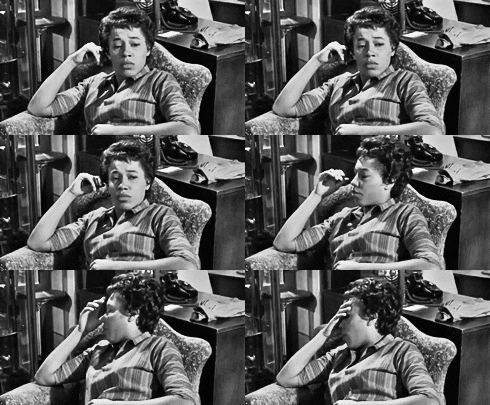
The loss of innocence through age is inescapable. With time, young idealism is violently met with the reality of systemic injustice and to prevent such a reunion is impossible. In A Raisin in the Sun, Mama is described as "being a woman who had adjusted to many things in life," weathered by and tired from laborious years of societal struggles. In contrast, Travis represents the vitality and adventurism of the youth and the preservation of innocence through censorship by older generations.
In an attempt to cover the hardships of daily life, Mama tends to Travis's chores, claiming "he's just a little boy" and that he "ain't supposed to know 'bout housekeeping" (40). And without explanation, Mama commands Travis to "hush up" (59) when he attempts to illustrate his childlike curiosity with the rogue rat. Mama's actions are representative of quiet conformation to societal ideals and institutional abandonment of pragmatic guidance and true education about the reality of struggles. Much like the "plant that ain't never had enough sunshine" (52), Travis doesn't receive the proper educational nutrition that is necessary to sprout understanding members of society. What is left of Travis's tenacious curiosity is a vague understanding that some things are right and some things are wrong.

The solution, I would argue, is like that of any other conflict: effective conversation between dissenting members. On a broader scale, this requires dialogue between people of, but not limited to, different generations, races, religions, and sexes. Bridging systemic chasms requires the full effort of people on both sides of the issue before it becomes too societally ingrained. 
The plant hasn't always been withered, but is it too late now?
Dec 11, 2016

Help! Do I have ghetto-itis?

In A Raisin in the Sun, we learn early on that the Youngers operate on a dysfunctional familial level. The "tired" furniture attempts to bring "care and love and even hope" and disguise the "weariness" of the residence, but it does none except exposes the Youngers' desire for a rich-white life. It's apparent that the "acute ghetto-itis" from chronic racism and sexism, created by an unjust system and perpetuated by an unjust society, has long-lasting symptoms on society's most vulnerable members.

Walter, pressured by the role of men to earn money to provide for his family, complains that his wife doesn't "understand about building" him up and making him "feel like [...] somebody." This exposes the fragility of Walter's masculinity and his inability to "be the man" in the family. When confronted by the reality of his aspirations, Walter threatens to "look for peace" outside of his home, escaping his responsibility of curing the dysfunctional home setting.

Ruth, pressured by the role of women to attend to domestic matters, is restricted by her identity of a "colored woman." She claims she "would rather be living in Buckingham Palace," in part mocking the futility of Walter's desires but also revealing her frustration at the entrapment of her current domestic and financial crisis. However, Ruth takes refuge in repetitively making breakfast and ironing clothes, demonstrating her fear of wading beyond the role of a colored woman.

It becomes evident that racism and sexism do not function individually. Rather, they work quite well in tandem to maintain a rigid socioeconomic framework, of which members functioning within the frame find it difficult to escape the societal template.

Dec 4, 2016

Corporate Cynicism

"I couldn't forgive him or like him, but I saw that what he had done was, to him, entirely justified. It was all very careless and confused. They were careless people, Tom and Daisy- they smashed up things and creatures and then retreated back into their money or their vast carelessness, or whatever it was that kept them together, and let other people clean up the mess they had made..."

This passage describes the separation of class, defined by the more obviously divide in monetary worth and less obviously divide in moral intentions. While reading the passage, I was surprised by the immediate relevance this passage held to modern events much discussed in America's political rhetoric.

In the wake of Obama's administration denying further construction of the North Dakota Access Pipeline, an act requested through turmoil and irritated voices, it is worth analyzing the corporate origins, much summarized in the passage, of the initial construction. For the first time in history, many Native American tribes unified against a common antagonist: Energy Transfer Partners, a corporation that represents blind greed and repetitive institutional infringement of Native American rights.

Energy Transfer Partners, and much of its political allies, has consciously ignored the cultural and historic relevance of the land the pipeline would have crudely run through and the environmental implications of the pipeline itself. As in the passage, Energy Transfer Partners and many other modern corporations "[smash] up things and creatures and then [retreat] back into their money or their vast carelessness," for profits outweigh humanity.

Because literature of any time period often reflects the predominant ideology, the passage from The Great Gatsby, exposes a cynical truth that was known back then and is ever more relevant today: a clear barrier exists between the goals of much of those surrounded in wealth and the reality of the repercussions of their destructive greed.