Oct 30, 2016

Plastic (Role) Models?

Barbie's life in plastic does seem rather fantastic; she has access to a limitless wardrobe, a lavish mansion complete with an elevator, and a dashing sports car (obviously in all pink). Not to mention, she has "her giant breasts and high-heeled feet" to look good for all the Kens in her world (354). Who wouldn't want breasts "so out of proportion" you would "fall flat on [your] face" (353)? Sounds to me like a once-upon-a-time fantasy without a happily ever after.

In today's society, these "twisted" ideals of women are subliminally incorporated into our culture: they're present in our music, our advertisements, and the list goes on. Women, therefore, are caught in a paradox. They are reminded of striving towards these unattainable, oversexualized, and rather plastic, features while being told that wearing revealing clothing is skimpy and having such features warrants being labelled a whore, a slut. However, being too covered up warrants being labelled an uptight Jesus-fanatic hag.

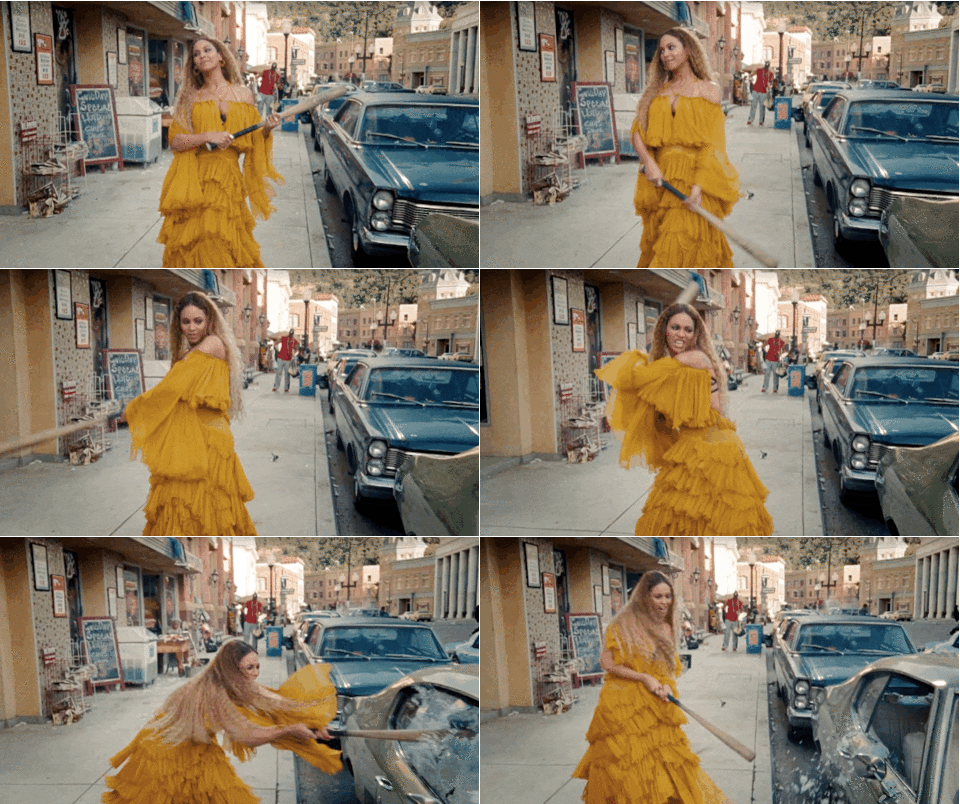
At a time like this, it seems almost crucial that everyone examines the true rhetoric of the feminist movement. The movement is about the "social, political, and economic equality for both sexes," as quoted by notable feminist Chimamanda Ngozi Adichie. These ideals can only be met with cooperation between both sexes in smashing down gender roles, with the enthusiasm of Beyonce smashing down windows.
As a society, we create unrealistic beauty ideals for women. Such that when women do fit the plastic mold, we act as if we're seeing pink elephants. Barbie can no longer be seen as a role model for children to aspire to be. Rather, she is a model for the patriarchy's fantasy, of which shall never have once upon a times or happily ever afters.

Oct 23, 2016

Is Race A Social Construct?

Plain and simply, I do not think race is socially constructed. The stigmas and stereotypes that revolve around race, indeed, are social constructs, but race itself is not.
To begin with, dictionary.com defines race, among other definitions, as "a human population partially isolated reproductively from other populations, whose members share a greater degree of physical and genetic similarity with one another than with other humans." Humans are given a set of genes that characterize individuals; they define skin color, hair color, eye color, bone structure, height, blood type etc. When a collection of people within a geographic region share similar physical characteristics, it is defined as a "race."
Some may argue that genetic variance among humans are minuscule; scientists have discovered that humans may only genetically differ by 0.1%. However, the genetic difference between humans and chimps is only 1.2%, and it goes without saying that there is a great disparity in physical appearance between humans and chimps. Point is, what seems to be minute genetic variance actually results in major physical differences, and it allows for the categorization of humans into subgroups based solely on physical characteristics. This plain categorization is purely objective.
When we base race purely on genetic variance and the resulting phenotypes, we remove all social implications and connotations associated with individual races. When we place race in context of society, however, stereotypes and stigmas form- it is these that are social constructs. Throughout history, race has been used to alienate, to segregate, and to discriminate groups of people. As demonstrated in the graphic novel Maus, Adolf Hitler subverts an entire population, claiming that "the Jews are undoubtedly a race, but they are not human." This history has led us to, at the present time, doubt race classifications of people based on physical appearance. While society is moving away from generalizing groups of people, it is worth distinguishing the difference between race and the connotations that come with race. As quoted by Will McAvoy in the TV series The Newsroom,"the first step in solving any problem is recognizing there is one." There exists a problem in the social constructs based on race, not in race itself. Race does not define any individual. People should, therefore, embrace their race, not the socially constructed connotations that are paired with it, as a biological component of their complex individuality.


Oct 15, 2016

Maus Analysis

At first glance, the graphic novel Maus has the characteristics of any other comic- speech bubbles, comic sans font, detailed graphics, animal characters, etc. Upon further review, however, Maus is anything but a conventional entertaining comic. Through the combination of pictures and words, Art Spiegelman attempts to represent the events and magnitude of the Holocaust, a feat that would otherwise be unattainable through the explicit use of words.
Art expertly implements many graphical techniques and literary devices to create layers of deeper meaning, specifically on page 59. At the very top of the page, the Jewish mice are lined up in front of the Nazi cats. The particular shading of the mice's uniforms mirror that of a prisoner outfit. This suggests that in the shadow of the Nazis, the Jews are always prisoners, a theme that recurs throughout the novel. However, it is worth noting that the Nazis are also shaded in this particular way. Perhaps the individual soldiers are prisoner to the entire Holocaust movement as they enact orders from officers above them in rank.
Below the top panel, Vladek notes that the Nazis "did everything very [systematically]." The organization of the individual panels illustrating Valdek's interaction with the Nazi mirrors that statement. Unlike other pages, the panels are of the same size. This accentuates the order with which the Nazis carried out their actions.
As the panels switch back from past the present, Art is demonstrated to be smoking, and the rising smoke acts as a physical separation between Art and his father. This represents the separation in experiences of the Holocaust between father and son; no matter what, Art will never fully be able to comprehend the magnitude of his father's experience in the Holocaust. Furthermore, the "panels" illustrating the past have no physical border unlike the panels illustrating the past. The present "panels" are encompassed by the panels describing the past, suggesting that both Vladek and Art are engulfed by the past, and both are unable to escape from it.
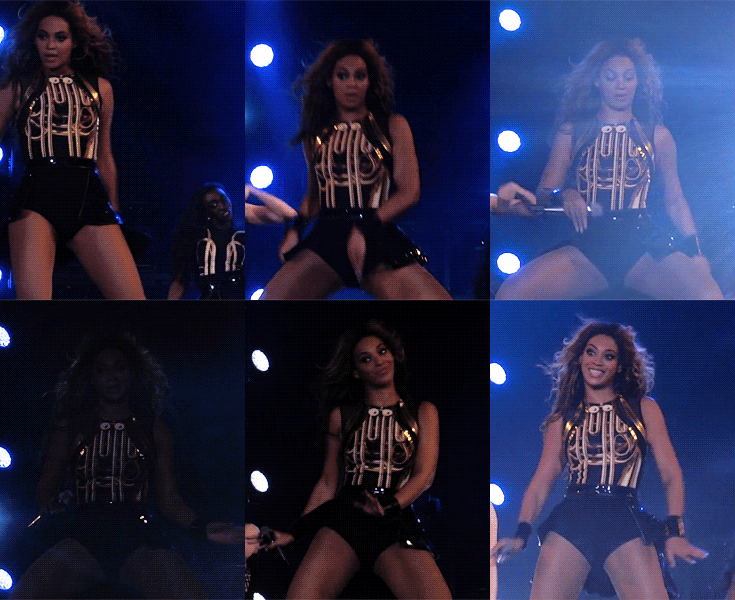
(Please enjoy this gif of Beyonce dancing. I only say this because I literally can't relate Maus and Beyonce, but every post needs her blessing.)

Oct 9, 2016

Gender Equality

From birth, gender norms are forced upon us. At the hospitals, girls are wrapped in pink blankets and guys are wrapped in blue blankets. As we grow up, we learn that pink is a flowery feminine color and that blue is a firm masculine color. Girls are "compelled to do housework," and society establishes that though it is the norm for girls to do housework, it is seen as "demeaning and degrading" (hooks 105). Guys are expected to be the physically strong money-makers so that they can "be the man" in the family and protect the dainty girl.
In the words of prominent feminist and social activist bell hooks, the "feminist movement will be sustained only if the needs of masses of women are addressed." It is evident, however, that gender stereotypes are equally damaging to both genders, and it is the role of the constantly evolving feminist movement to address the double standards that exist for both genders in multiple aspects of life.

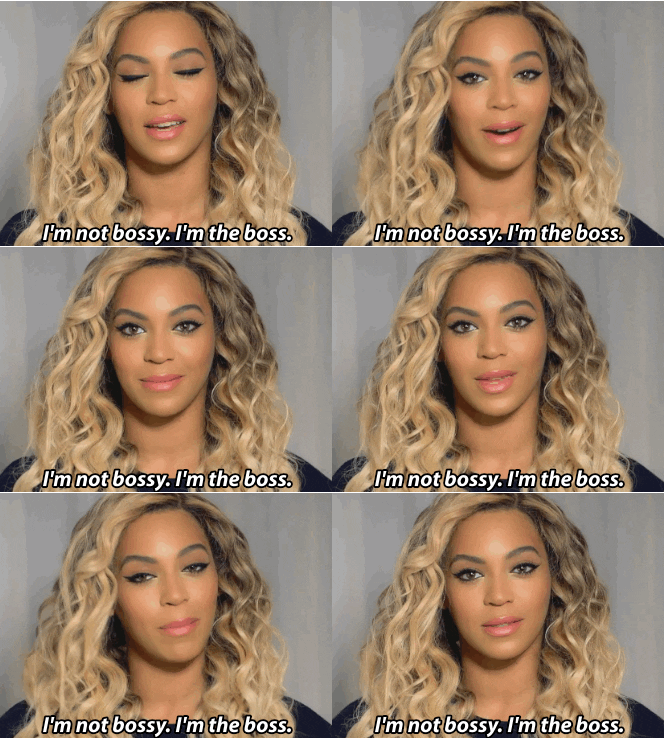
1) Bossy versus Boss
While guys are generally encouraged to be direct and commanding, as society views these traits as integral to effective leadership and CEO material, girls are discouraged from doing the same because they will come off as bossy or bratty, and we all know girls can't be CEOs, right? And if guys aren't able to be direct and commanding, they will come off as being a submissive push-over.


2) Beauty Standards
The current feminist movement does well in addressing the unrealistic body expectations of females. Society imposes "the perfect body" as skinny with certain accentuated sexual features. The current feminist movement, however, does not also address the over sexualized body images of men in many advertisements, presenting them as very apparently chiseled and muscular figures.

The above examples are just a sliver of the countless gender expectations imposed on both males and females. The emergence of the feminist movement in the 60s served to counter gender inequalities. At that time, the disparity between males and females was much greater than it is today, and the purpose of the feminist movement was to address the female perspective of these inequalities. However, with an evolving society that imposes gender norms, the "future feminist movement will be sustained only if the needs" of both men and women are addressed (hooks 107).

Oct 2, 2016

Morality in Government

As a child, I went to church every Sunday. I sang hymns and read verses of the Bible. I believed everything that was spoon-fed to me, and, in the words of transcendentalist Henry David Thoreau, "they [forced] me to become like themselves." Perhaps I lost sight of the meaning of Christianity, but what has disturbed me the most about going to church was the fact that, at least in the way I was taught, I was supposed to live my life a certain way because God, a character that seemed so distant from me, willed it and because I was told so by my pastor.

Now, a few Sundays spent sleeping in later, I believe that, with the influence of Thoreau's writing, insinuating one's morals and beliefs on another is unnatural and damaging. No one person has the right to claim his/her standards and morals are more righteous than another. For instance, one society may view homosexuality as a sin while another may view it as a natural sexual preference. However, there is no telling which society is the more 'righteous' one because each respective society views its belief as the 'correct' one.

In modern American democracy, the role of the government is to pass and enact laws that are meant to keep people within a rigid set of morals that the government sees as righteous. Let me remind you that slavery was legal and same-sex marriage was illegal until the summer of 2015. This gives testimony to the fact that standard morals are subjective and continuously changing with evolving societies and that 'unrighteous' laws are intrinsic in our patchy legal code.

Disclaimer: To begin with, I do think disclaimers will be a staple in my posts since they cover generally controversial topics. I do not mean to attack the idea/existence of religion nor its believers. Following a religion, at least in my experience, requires a commendable amount of persistence and faith.