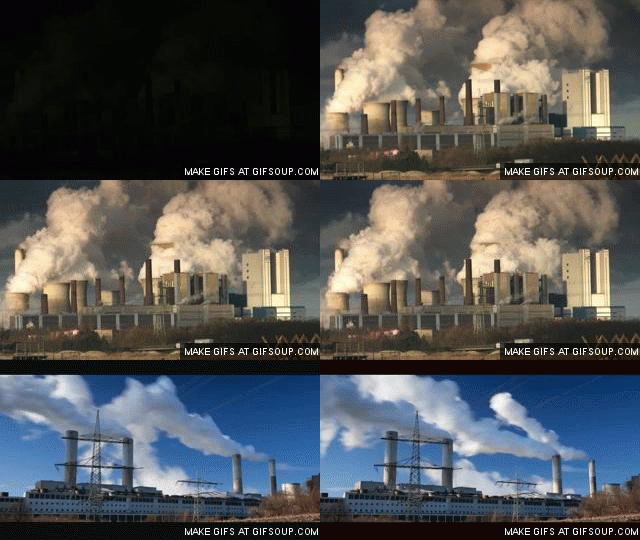
While filming, re-filming, and editing, my NHS speech video, I realized it is certainly impossible to capture every living moment. Especially in a transitioning age from Polaroids to digital media, pictures are becoming less permanent and easily re-doable. Sontag's claim "that photography limits our understanding of the world" is true; photography and film, for better or for worse, distort reality by glamorizing life as it is for aesthetic pleasure or personal validation. The development of various social media platforms reinforces these bad habits.
Through the lens of just one camera, we only ever attempt to capture the highlights of life, and apps like Snapchat allow us to broadcast those moments in 10 second clips. The reality our friends and ourselves come to know become disillusioned by disjointed streams of filtered snippets. This is, indeed, "the opposite of understanding" if what is accepted as true has only been reached through several takes. To satisfy less immediate needs for attention, Instagram allows us to display our life in grids of square pictures. An underlying motivation keeps us coming back to Instagram and perpetuates a cycle of "aesthetic consumerism": the hunt for likes. This most dangerous game quantifies the quality of life through the number of likes and people reached.
Others may argue that photographs bring about a degree of reality; take photographs of Syria, for example. True, the destruction and terror is visually displayed, but the constant exposure desensitizes society to the harsh reality and creates a humanistic barrier; we can't smell the blood, can't hear the bombs and subsequent cries, can't taste the ash, and can't feel the scorching heat of the constant shelling.
Photographs create a reality guarded by facades and forced smiles: say cheese!
Unlike conventional campaigns, my campaign is not about votes. Unlike conventional campaigns, my campaign is less about public opinion than it is about self reflection and analysis of societal issues that will be discussed in 11 AP English, which, in turn, can (and hopefully will) incite thoughtful public debate. *Forewarning: look forward to countless Beyonce references!!
Apr 23, 2017
Mar 18, 2017
Blurred Lines
Amidst the current state of political turmoil and muddled by the slanted free press, political correctness becomes yet another divisive issue; conservatives claim the sensitivity of society detracts from the common sense while liberals claim the changing language reflects a society of diversity and inclusion. Where do we draw the line?
In November, the American population voted in a demagogue, hailed for not actually being a politician and being able to speak his mind. Criticized for calling women "pigs," immigrants "rapists," and Muslims "terrorists," Trump claims it is an issue of an increasingly politically correct country. In early February, Breitbart editor Milo Yiannopoulos was forced to cancel his speech at UC Berkeley after violent protesters made it clear his rhetoric violated the principles of inclusion, a form of "intolerance (in the name of tolerance)." Conservatives were outraged by such a limitation of free speech. Liberals said it was not a matter of free speech; rather, it was a limitation on hate speech. The line becomes blurrier and political epithets are thrown across the aisle.
The nature of language should be to fit the message with accuracy and clarity; "let the political chips fall where they may." The "hijacking" of language on both sides of the political spectrum distracts from the severity of the issues at hand. There is no need for worrying about where to draw the line if there is no need for one at all.
In November, the American population voted in a demagogue, hailed for not actually being a politician and being able to speak his mind. Criticized for calling women "pigs," immigrants "rapists," and Muslims "terrorists," Trump claims it is an issue of an increasingly politically correct country. In early February, Breitbart editor Milo Yiannopoulos was forced to cancel his speech at UC Berkeley after violent protesters made it clear his rhetoric violated the principles of inclusion, a form of "intolerance (in the name of tolerance)." Conservatives were outraged by such a limitation of free speech. Liberals said it was not a matter of free speech; rather, it was a limitation on hate speech. The line becomes blurrier and political epithets are thrown across the aisle.
The nature of language should be to fit the message with accuracy and clarity; "let the political chips fall where they may." The "hijacking" of language on both sides of the political spectrum distracts from the severity of the issues at hand. There is no need for worrying about where to draw the line if there is no need for one at all.
Mar 12, 2017
EPA and What it Really Stands For
In "Save the Whales, Screw the Shrimp," Joy Williams criticizes the Environmental Protection Agency for its lack of strict regulation so as not to impede on economic progress- a sort of Economic Protection Agency. With Trump's administration, it's hard to distinguish between our worst nightmares and the harsh reality of it all.
The Bulletin of Atomic Scientists announced that the Doomsday Clock was moving 30 seconds closer to the end of humanity in an "unpresidented" act; never before has the Clock been moved as a result of a single person, but Donald Trump's alarming remarks on nuclear advancement and climate change has a resounding effect. Scott Pruitt, an outspoken climate change denier, is the newly appointed and confirmed Administrator of the EPA (never mind the fact that he has sued the EPA on 13 occasions). He disagrees with the facts on climate change and its effects on the health of the environment: after all, we are in an "age of radical subjectivism." Under this administration, Trump will oversee massive cuts to the budget, employment, and work of the EPA, allowing corporations to run its roads and tracks through the land like a synthesized backbone, to purge its sludge in the lakes, and to emit loads of gas into the vast atmosphere. Like the "poor old sea turtle [...] depositing her five gallons of doomed eggs," even a most natural process seems manufactured.
This, I argue, is not a case of ignorance: it's one of purposeful self-destruction.
The Bulletin of Atomic Scientists announced that the Doomsday Clock was moving 30 seconds closer to the end of humanity in an "unpresidented" act; never before has the Clock been moved as a result of a single person, but Donald Trump's alarming remarks on nuclear advancement and climate change has a resounding effect. Scott Pruitt, an outspoken climate change denier, is the newly appointed and confirmed Administrator of the EPA (never mind the fact that he has sued the EPA on 13 occasions). He disagrees with the facts on climate change and its effects on the health of the environment: after all, we are in an "age of radical subjectivism." Under this administration, Trump will oversee massive cuts to the budget, employment, and work of the EPA, allowing corporations to run its roads and tracks through the land like a synthesized backbone, to purge its sludge in the lakes, and to emit loads of gas into the vast atmosphere. Like the "poor old sea turtle [...] depositing her five gallons of doomed eggs," even a most natural process seems manufactured.
This, I argue, is not a case of ignorance: it's one of purposeful self-destruction.
Mar 5, 2017
Liberation through Diversity
In her essay, Deborah Tannen claims that "there is no unmarked woman." Every bit of a woman, from her "decisions about hair, clothing, makeup, and accessories," is under scrutiny; men, on the other hand, have the luxury of choosing between marked and unmarked styles. While biological and linguistic bases for being marked exist, it is established social norms that truly cultivate stigmas against marked styles. The solution, I would argue, is exposure to and acceptance of diversity where everyone is marked in an individual sense and being unconventional is the new established norm. Is it possible? Perhaps not (not anytime soon anyway).
Alienation based on physical differences is not foreign to the history of the world, not even in the recent past. In 2011, France instituted a ban on the burqa. a veil worn by an estimated 2,000 women out of the 5 million Muslims in France. This ban, controlled by the angry and fearful rhetoric of a misunderstanding minority, legally and socially marked the burqa. In 2016, Chancellor Angela Merkel proposed a similar ban in Germany- this was done to alleviate the criticisms of the more conservative and anti-immigrant elements against the open-door-policies benefiting refugees. In essence, the political maneuvering came at the expense of personal freedom, yet again, legally and socially establishing a social norm.
In a present-and arguably peretual- state of alienation and divisiveness, how are we to escape scrutiny from marked appearances?
Alienation based on physical differences is not foreign to the history of the world, not even in the recent past. In 2011, France instituted a ban on the burqa. a veil worn by an estimated 2,000 women out of the 5 million Muslims in France. This ban, controlled by the angry and fearful rhetoric of a misunderstanding minority, legally and socially marked the burqa. In 2016, Chancellor Angela Merkel proposed a similar ban in Germany- this was done to alleviate the criticisms of the more conservative and anti-immigrant elements against the open-door-policies benefiting refugees. In essence, the political maneuvering came at the expense of personal freedom, yet again, legally and socially establishing a social norm.
In a present-and arguably peretual- state of alienation and divisiveness, how are we to escape scrutiny from marked appearances?
Feb 26, 2017
White House: A Gendered Space
Sexism runs deep in American history. Only after 19 amendments and 144 years of struggle are women merely granted the right to vote; 97 years later women all around the world march to support basic women's rights. Have we really liberated ourselves from the patriarchy? It's influence spreads across multiple facets of life and has seeped into our country's most respected office- the White House.
1920:
2017:
Though the political climate and economic state of America fluctuates between periods of highs and lows, one thing is constant: a male president is elected or re-elected every four years. Even when presented with the first female candidate, America elects a misogynist with an attitude of a kindergartner robbed of his afternoon nap. After all, how are we to trust a female with executive decision making? Surely, we can trust her "to cook [our] meals, wash [our] clothes," wash the dishes, clean the home, be arm candy, model clothes, and other tasks that female hormones don't inhibit. Anything beyond home economics is the unpredictable and insecure space of male dominance, and it's a threat for a female to venture into these spaces. In this sense, "No one is as fragile as a woman but no one is as fragile as a man."
Eleanor Roosevelt, Rosa Parks, Cleopatra, Malala Yousafzai, Amelia Earhart, Sojourner Truth, Sacagawea (and the list goes on) have all demonstrated the power and influence of females. Why, then, is the center of power and influence in the free world reserved for males?
1920:
2017:
Though the political climate and economic state of America fluctuates between periods of highs and lows, one thing is constant: a male president is elected or re-elected every four years. Even when presented with the first female candidate, America elects a misogynist with an attitude of a kindergartner robbed of his afternoon nap. After all, how are we to trust a female with executive decision making? Surely, we can trust her "to cook [our] meals, wash [our] clothes," wash the dishes, clean the home, be arm candy, model clothes, and other tasks that female hormones don't inhibit. Anything beyond home economics is the unpredictable and insecure space of male dominance, and it's a threat for a female to venture into these spaces. In this sense, "No one is as fragile as a woman but no one is as fragile as a man."
Eleanor Roosevelt, Rosa Parks, Cleopatra, Malala Yousafzai, Amelia Earhart, Sojourner Truth, Sacagawea (and the list goes on) have all demonstrated the power and influence of females. Why, then, is the center of power and influence in the free world reserved for males?
Feb 19, 2017
A Disagreement
Joan Didion is right when she says Las Vegas "is the most extreme and allegorical of American settlements." Blinding lights penetrate every corner and blanket the night sky, half-naked women parade the streets as onlookers line up to snapshot the spectacle, and towering casino hotels create a concrete labyrinth, removing all sense of time and geological location. There is no remembrance of the past in the future; there is just the raw feeling and emotion of the present. After all, what happens in Vegas stays in Vegas (but that's the whole beauty of it).
People journey to Vegas to escape the dry routine and traditional limits of everyday life, be it touring the Strip, drinking, gambling, buying into the commercialized marriage industry, or experiencing a tasteful combination of all- it's not my position to judge. In a place where the "tone [...] is set by mobsters" and alcohol is breathed in, can we really blame one for buying into impulse?
When we watched the video of the drive-through marriage service, I couldn't help but think how fun it would be order an over-the-counter marriage. It certainly is a break from traditional and "proper ritual," but isn't that what Vegas was found on?
Feb 12, 2017
Sunday Night Interview
As the son of generally well established first-generation immigrants, I did not have to live an immigrant life. It had not even occurred to me to ask about my parents' story, about what it was like to "start anew." It's clear now that their story is every bit a part of my story.
Me: "What was your first impression of America?"
Dad: "Spacious. There were no tall buildings, and everything was so spread out."
It's no doubt that we Americans comfortably enjoy the vast amount of space we have, especially between houses. I've lived in my neighborhood for six years now, and I don't completely know the names of my next-door neighbors. I attribute this to when we do actually see each other, the thought of having to awkwardly shout across the lawn with the chance of being inaudible anyway discourages any interaction altogether.
Me: "What was the most interesting part of America?"
Dad: "Hooters. And Twizzlers- they taste like rubber hoses. And the large sizes of everything."
Mom: "The large scale natural scenery, like the Yellowstone National Park and Grand Canyon."
Regarding Hooters, I dared not ask further- "there are limits to what even interested persons can ask of each other." Nonetheless, largeness is clearly a motif in American culture. While the grandeur overproduction and mass-consumption of all things American may be seen as glutinous and savagely-grotesque, this was, in my parents' eyes, one of the most alluring qualities. Perhaps, this was a repulsive kind of interest, the kind of disgust that you can't help but continuously probe at until you become used to it.
Me: "In terms of all the American liberties, which is your favorite right?"
Dad: "The fact that a basic human right was the Pursuit of Happiness. Back in Taiwan, you know, it was about responsibility and contributing to the country. I felt this was a big difference."
To my dad, America is where you can contribute to the country without compromising personal happiness, where you can happily sing karaoke in the comfort of your home, where you can barbecue all-American hotdogs on lazy summer afternoons, where you can gulf down a large bag of popcorn while watching Star Wars in IMAX 3D, where you can live in a utopian community with an exceptional education system, where you can enjoy the simple luxuries of Somerset Mall and the cheap goods of Walmart... . There's a lot to celebrate.
Me: "What was your first impression of America?"
Dad: "Spacious. There were no tall buildings, and everything was so spread out."
It's no doubt that we Americans comfortably enjoy the vast amount of space we have, especially between houses. I've lived in my neighborhood for six years now, and I don't completely know the names of my next-door neighbors. I attribute this to when we do actually see each other, the thought of having to awkwardly shout across the lawn with the chance of being inaudible anyway discourages any interaction altogether.
Dad: "Hooters. And Twizzlers- they taste like rubber hoses. And the large sizes of everything."
Mom: "The large scale natural scenery, like the Yellowstone National Park and Grand Canyon."
Regarding Hooters, I dared not ask further- "there are limits to what even interested persons can ask of each other." Nonetheless, largeness is clearly a motif in American culture. While the grandeur overproduction and mass-consumption of all things American may be seen as glutinous and savagely-grotesque, this was, in my parents' eyes, one of the most alluring qualities. Perhaps, this was a repulsive kind of interest, the kind of disgust that you can't help but continuously probe at until you become used to it.
Me: "In terms of all the American liberties, which is your favorite right?"
Dad: "The fact that a basic human right was the Pursuit of Happiness. Back in Taiwan, you know, it was about responsibility and contributing to the country. I felt this was a big difference."
To my dad, America is where you can contribute to the country without compromising personal happiness, where you can happily sing karaoke in the comfort of your home, where you can barbecue all-American hotdogs on lazy summer afternoons, where you can gulf down a large bag of popcorn while watching Star Wars in IMAX 3D, where you can live in a utopian community with an exceptional education system, where you can enjoy the simple luxuries of Somerset Mall and the cheap goods of Walmart... . There's a lot to celebrate.
Jan 29, 2017
Keeping Up with the Downs
While the Trump family has temporarily captured national spotlight, one distinguished family has captured the hearts of Americans: the Kardashians. The Kardashians actually have more in common with other Americans than what one may think- they love to go on vacation, strive to meet their soulmates, and most likely have an appetite for pizza and McDonald's fries. They just happen to be richer and more dramatic than most American families (and star in their own reality show).
Keeping Up with the Kardashians, like many other reality shows, offers to capture the essence of day-to-day life for a unique group of people and to broadcast this unseen perspective. However, the mere creation of such a show establishes a separation between the Kardashians and common folk- a "kind of effacement or isolation" (Mairs 14).
In the show Born This Way, people with Down Syndrome are displayed as doing "normal people" things like having fun with friends at a bowling alley, having passions for acting, or having crushes on other people. The show's trailer is even captioned with this: "meet the seven young adults with Down syndrome who are defying society's expectations every day." While the original intentions of the show may be to reveal the potential and capability of people with disability, presenting them doing day-to-day things as groundbreaking and defying work inadvertently progresses the negative stereotype that disabled people are definitely incapable.
Mairs asserts "that we insert disability daily into our field of vision" to achieve a quiet and natural normalization of disability (Mairs 15). A Kardashian-esque reality show does that no justice and neither does a President who mocked a disabled reporter. It's no wonder the Trump family has captured national spotlight: they unfortunately have captured our eyes and ears too.
Subscribe to:
Comments (Atom)